
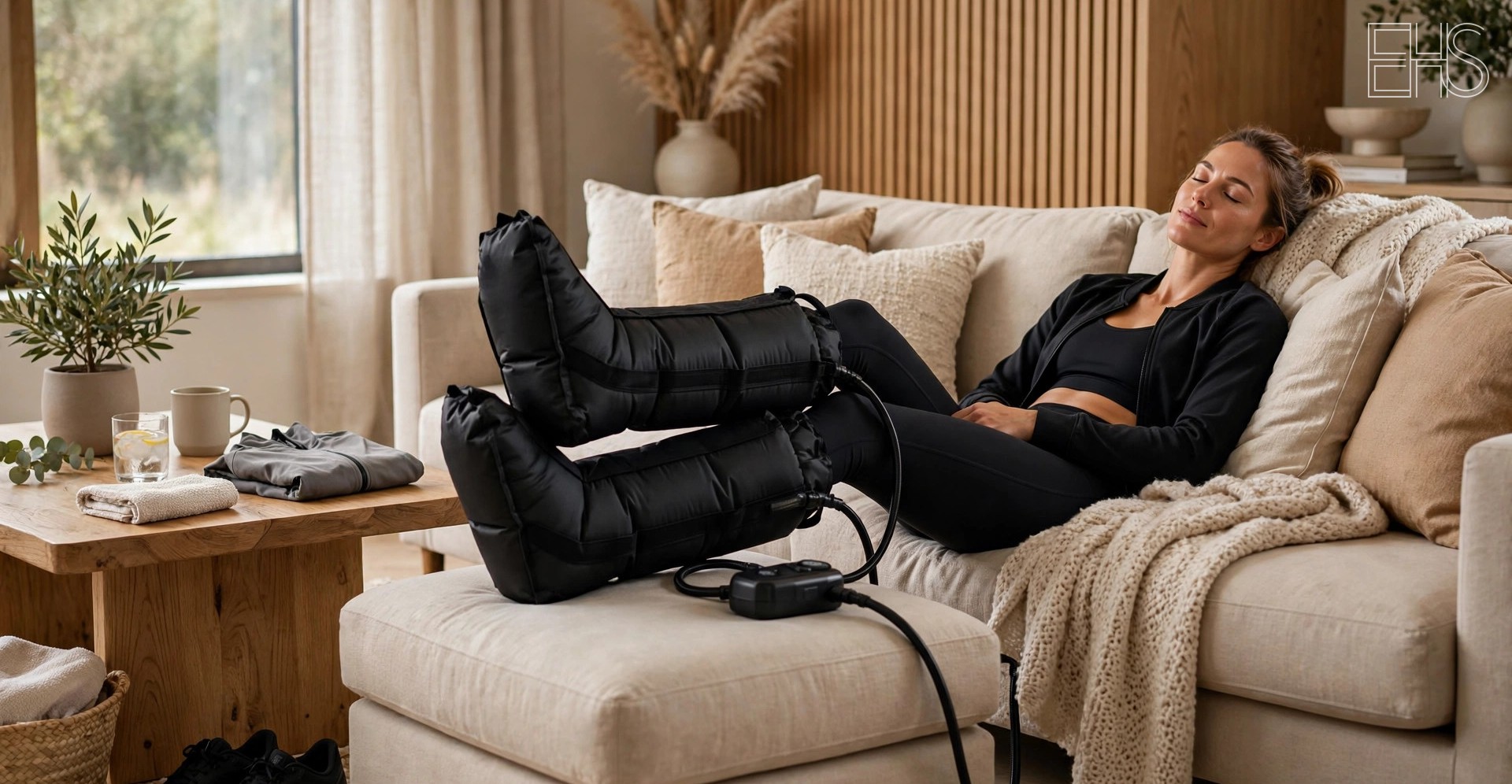
Pneumatic compression boots have completed the classic wellness journey: from professional cycling teams and training rooms to airport lounges, boutique recovery studios, and living rooms. Slip your legs into the sleeves, press start, and sequential chambers inflate from ankle to hip in a slow, rhythmic squeeze that feels like a very patient massage. The sensation is pleasant enough that the claims barely needed help: faster recovery, flushed legs, better circulation, legs made new overnight.
The research, as usual, is more measured than the sensation. Compression does some real things, probably does a few more, and definitely does not do several of the things printed on the box.
What the Devices Do
Modern recovery compression is pneumatic and sequential: air chambers inflate in sequence from the extremities inward, creating a gradient of pressure that peaks distally and releases proximally. Sessions typically run 20 to 60 minutes at pressures users can adjust. The proposed mechanism is straightforward: external pressure assists venous return and lymphatic flow, moving fluid out of the limbs, which should reduce that heavy-legged feeling after hard efforts.
This is distinct from compression garments (socks, tights), which apply static graduated pressure and have their own smaller literature, and from massage, which involves shear and manipulation rather than uniform squeeze. Studies of one do not automatically apply to the others, though marketing often presents them as interchangeable.
Why This Literature Is Tricky
- Subjective outcomes dominate. Perceived soreness, perceived fatigue, and perceived recovery are the most common endpoints, and they are exactly the outcomes most susceptible to placebo and expectation. A novel, expensive, pleasant-feeling device is a powerful expectation machine.
- Blinding is nearly impossible. Participants know whether their legs are being rhythmically squeezed. Sham compression exists in some trials but is unconvincing as a control.
- Timing and protocols vary. Studies differ in when compression is applied (immediately post-exercise, hours later, next day), for how long, and at what pressures, making the literature hard to pool.
- Athlete-heavy samples. Most trials study trained athletes after intense exercise, not recreational exercisers or travelers with tired legs.
What the Evidence Suggests
Perceived soreness and perceived recovery: moderate support
The best-supported claim, and it comes with the caveat above. Multiple small trials and at least one systematic review have found that pneumatic compression after intense exercise reduces perceived muscle soreness and improves subjective recovery scores compared with passive rest, typically in the 24 to 48 hours after exercise. The effect is consistent enough to take seriously and subjective enough to keep in perspective.
Practical takeaway: if your legs feel wrecked after a hard session, compression likely helps them feel better. That is a legitimate use with real evidence behind it, even if the mechanism of the feeling is partly expectation.
Objective performance recovery: weak
When researchers measure what the legs can actually do afterward, strength, power output, sprint times, jump height, the benefits shrink or vanish. Most trials find little to no meaningful improvement in objective performance markers with compression versus passive recovery. The legs feel readier than they measure.
Practical takeaway: compression is better at changing how recovery feels than how it measures. For athletes, that distinction matters: feeling fresh and being fresh are different things.
Blood flow and fluid movement: plausible mechanism, modest direct evidence
The proposed mechanism, assisted venous return and lymphatic flow, is physiologically sensible, and a few studies using imaging or circumference measures show small reductions in limb swelling after exercise with compression. But direct measurements of blood flow changes during and after pneumatic compression are limited, and the link between the fluid shifts and the soreness benefits is assumed more than demonstrated.
Practical takeaway: the mechanism story is coherent but under-measured. Sensible is not the same as shown.
Swelling after travel or long days: reasonable but thin
The use case many owners actually love, heavy legs after flights or long days standing, has the least formal study behind it and some of the most plausible mechanism. Gradient compression was developed for fluid management, and travelers' anecdotal reports are consistent. But controlled trials of pneumatic boots specifically for travel-related leg heaviness are scarce.
Practical takeaway: plausible, popular, under-studied. Compression socks, which have more travel-specific evidence, may be the more economical experiment. A short note: pneumatic compression involves real pressure on your limbs, and like any pressure-based practice, it is not for everyone. Anyone with circulation concerns should check with a qualified professional before making it a habit.
Flexibility and range of motion: weak
A few trials report small, transient improvements in range of motion after compression, but the effects are inconsistent and short-lived. There is no good evidence that regular boot sessions produce lasting flexibility changes.
Practical takeaway: if flexibility is the goal, the evidence favors actual stretching and mobility work.
"Flushing lactic acid and toxins": retire on arrival
Lactate clears from muscles within an hour or so of exercise regardless of what you do afterward; it was never pooling in the legs waiting to be squeezed out. And "toxins," as ever in wellness marketing, refers to nothing measurable. This claim misunderstands basic exercise physiology and should be retired wherever it appears.
Recovery Modalities, Compared
Compression boots are one option in a crowded recovery market. How the evidence stacks up across the common choices:
| Modality | Evidence for perceived recovery | Evidence for objective recovery | Typical list price |
|---|---|---|---|
| Pneumatic compression boots | Moderate | Weak | Typically listed from around $500 to $1,500 for home systems |
| Compression garments (socks, tights) | Modest | Weak | Typically from around $30 to $150 |
| Massage guns (percussive) | Modest | Weak | Typically from around $100 to $500 |
| Manual sports massage | Moderate | Weak to modest | Typically from around $80 to $200 per session |
| Cold water immersion | Moderate | Weak to modest | Varies widely; see our tub guide |
| Active recovery (easy movement) | Modest | Modest | Free |
The table tells a humbling story for the whole category: nearly every recovery modality helps people feel better with limited evidence of changing objective recovery. Compression boots sit comfortably in the middle of that pack, distinguished mostly by price and pleasantness. Studio sessions typically run from around $30 to $60, and prices move with promotions, so verify current rates before booking.
The Claims to Retire
| Claim | Verdict |
|---|---|
| "Flushes lactic acid" | False. Lactate clears on its own within about an hour; nothing needs flushing. |
| "Removes toxins from the legs" | Meaningless. No measurable toxins are involved. |
| "Speeds muscle repair" | No good evidence of accelerated tissue repair; the benefit is in perceived soreness. |
| "Boosts circulation for hours" | Unproven. Small fluid shifts are plausible; lasting circulatory changes are not shown. |
| "Replaces rest days" | Nothing in the literature supports this. Recovery modalities complement rest; they do not replace it. |
| "The more pressure, the better" | Unsupported and unwise. Higher pressure has not shown better outcomes and adds discomfort. |
What Would Change Our Minds
The field needs what the whole recovery literature needs: larger trials with objective outcomes (strength, power, and performance measured over days, not just soreness questionnaires), credible sham controls, and standardized protocols so studies can be compared. Direct measurements of blood flow and fluid shifts during compression, tied to those outcomes, would connect the plausible mechanism to the reported benefits. Until then, compression sits where most recovery tech sits: genuinely pleasant, probably helpful for how you feel, unproven for what your muscles are doing.
The Honest Bottom Line
Compression therapy is one of the more honest products in the recovery market, which is not the same as saying its marketing is honest. The boots do something real: after hard exercise, legs feel better with compression than without, and that effect shows up consistently enough to trust. What they do not do is accelerate the underlying physiology of recovery in any way researchers can measure, flush anything that needs flushing, or substitute for sleep, nutrition, and rest. Buy them for the feeling, which is considerable, and keep the physiology in perspective.
For related reading, our contrast therapy protocols cover heat-and-cold routines with their own recovery evidence, our cold plunge versus sauna comparison weighs two recovery heavyweights, and our guide to cold plunge tubs covers what to look for if cold is your preferred modality.
Frequently Asked Questions
Do compression boots actually speed up muscle recovery?
They speed up how recovered you feel, which the evidence supports moderately, but they have not been shown to speed up objective recovery: strength, power, and performance measures generally show little difference versus rest. The distinction matters most for athletes timing their next hard session.
How do compression boots compare to massage guns?
Both have modest evidence for perceived recovery and weak evidence for objective measures, so the honest answer is that neither is clearly superior. Boots are passive and cover the whole limb; massage guns are active, targeted, and cheaper. Many athletes own both and choose by mood, which the evidence does not contradict.
Are compression socks as good as the boots?
For travel-related leg heaviness, socks have the more practical evidence base and a fraction of the price. For post-exercise recovery, the boot literature is somewhat stronger, but the gap is modest. Socks are the economical first experiment; boots are the upgrade for people who use compression often enough to justify it.
How often should you use compression boots?
Studies typically use single sessions of 20 to 60 minutes after exercise, and there is no good evidence for an optimal weekly frequency. Daily use is common among owners and appears low-risk for healthy users, but "more is better" has no support. Treat it as a post-hard-effort tool rather than a daily requirement.
Can compression boots help with swelling after flights?
Plausibly, yes: gradient compression was developed for fluid management, and traveler reports are consistently positive. Formal trials of pneumatic boots for travel specifically are scarce, so this rests more on mechanism and anecdote than on data. Compression socks are the better-studied travel option.
Is there anyone who should avoid compression boots?
Because the devices apply real pressure to the limbs, they are not for everyone. Anyone with circulation problems, a history of blood clots, or significant swelling of unknown cause should check with a qualified professional before using them. Higher pressure settings have no demonstrated added benefit, so there is no reason to push past comfort.
The information here is educational and general, not advice tailored to you. Please consult a qualified professional before making health decisions.