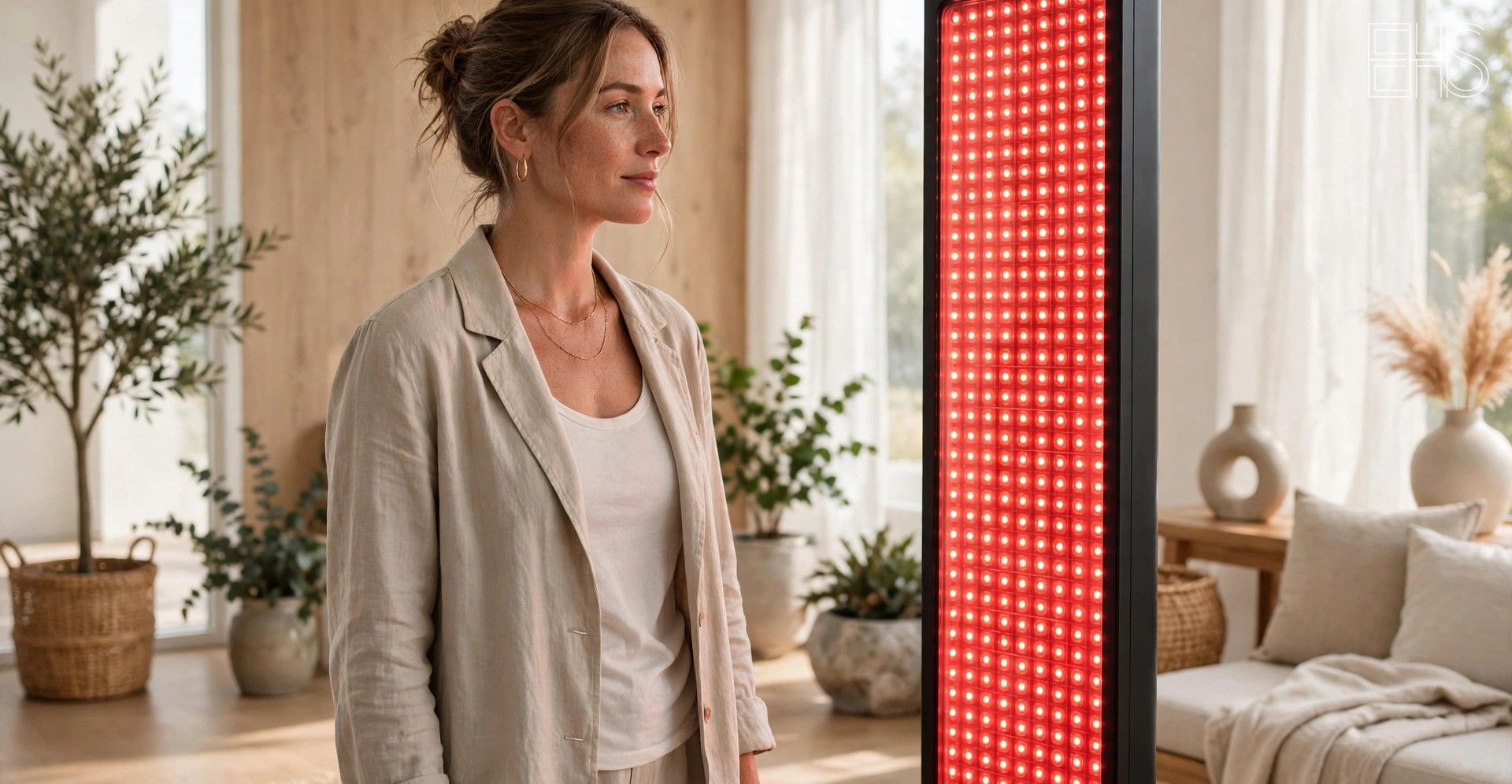
Stand in front of a red light panel for ten minutes and you are, according to the marketing, doing something for your skin, your muscles, your mitochondria, your sleep, and your mood, all at once. Red light therapy, known in the literature as photobiomodulation, has become one of the fastest-growing categories in home wellness, with panels ranging from handheld wands to full-body arrays that glow like something out of a science film.
The underlying mechanism is genuinely interesting, which is what makes the category worth examining rather than dismissing. But the distance between what studies suggest and what sales pages promise is wide, and it deserves a careful walk.
How to Read This Literature
Photobiomodulation research has a few quirks that make it harder to interpret than most wellness science:
- Dosing chaos. Wavelength (usually 630 to 850 nanometers), irradiance (power density at the skin), distance from the device, and session length all matter, and they vary enormously across studies. Two trials can both be "red light therapy" and share almost nothing else.
- Device heterogeneity. A flexible LED mask and a wall-mounted panel with 300 diodes are studied under the same umbrella term, though they deliver very different doses to very different areas.
- Small samples and short timelines. Many trials enroll 20 to 60 people and run for 4 to 12 weeks. That is enough to detect changes in skin appearance or soreness scores, and not enough to say much about long-term effects.
- Industry funding. A meaningful share of the trials are funded by device manufacturers, which does not invalidate them but warrants a raised eyebrow at unusually glowing results.
- Publication bias. As with cold exposure research, positive findings publish faster and louder than null ones.
The honest calibration: moderate confidence for short-term, directly observed effects like skin appearance; low confidence for systemic claims like fat loss or longevity.
Skin and Wrinkles: Moderate Support
This is the best-studied application and the one with the most consistent findings. Multiple randomized trials have reported improvements in skin appearance, including wrinkle depth, skin tone evenness, and measures of collagen density, after 8 to 12 weeks of regular red or near-infrared light sessions. The proposed mechanism, that light in these wavelengths is absorbed by mitochondria and influences cellular energy processes, is plausible and widely discussed in the literature.
A few caveats keep this in the "moderate" rather than "strong" column. Effect sizes are modest, the kind of improvement a careful observer notices rather than a transformation. Many of the best-known trials were small, and several involved manufacturer funding. Still, if any claim in this category survives contact with the evidence, it is the skin one.
Practical takeaway: consistent use over two to three months is associated with modest improvements in skin appearance in published trials. Expect subtle, not dramatic.
Muscle Recovery and Soreness: Some Support
A number of studies have examined photobiomodulation before or after exercise, looking at perceived soreness, strength recovery, and markers of muscle fatigue. The pattern that emerges is genuinely interesting: several trials found reduced soreness and faster recovery of performance measures compared with sham treatment, particularly when the light was applied before exercise.
The catch is dosing. The studies with positive results used specific wavelengths, power densities, and timing protocols, often applied by researchers with calibrated equipment. Whether a consumer panel used casually at home reproduces those doses is an open question, and the null results in the literature tend to come from protocols that differ in dose or timing. This is a field where the details are the intervention.
Practical takeaway: the pre-exercise recovery application has the most interesting athletic evidence, but results depend heavily on dose, and home setups may not match study conditions.
Hair Loss: Limited and Narrow
Red light devices for hair regrowth, usually in the form of caps or helmets worn for minutes per day, have been studied in several randomized trials, mostly in people with pattern hair loss. Some trials reported increased hair density compared with sham devices over 16 to 26 weeks.
The evidence is narrower than it looks. The trials are small, the effect sizes modest, and nearly all focus on one specific type of hair loss. There is essentially no evidence for regrowing hair lost to other causes, and the long-term durability of any gains is unstudied. This is a "maybe, for some people, modestly" finding, not a restoration technology.
Pain and Joints: Thin
Photobiomodulation is marketed for joint discomfort, back pain, and arthritis symptoms, and there are trials in this area. The results are mixed: some small studies report reduced pain scores, others show no difference from sham. The better-designed trials with larger samples tend to be the less enthusiastic ones, which is a pattern worth noticing.
Practical takeaway: the pain evidence is the weakest of the major claims, and the most likely to be reshaped by future, larger trials.
Fat Loss and Body Contouring: Weak
This is where the marketing most clearly outruns the science. The claim that red light sessions reduce body fat or reshape the waistline rests on a small number of trials with inconsistent results, unusual protocols, and in some cases direct manufacturer involvement. Where fat measurements changed at all, the changes were small and their durability unstudied.
Our home guide covers what the devices actually do and what to look for when comparing them. But on the fat-loss claim specifically, the honest grade is: not supported by the current literature in any form a buyer should rely on.
Sleep and Mood: Emerging, Not Established
A handful of small studies have looked at red or near-infrared light exposure in the evening and reported associations with subjective sleep quality or relaxation. The proposed mechanism, that red-spectrum light in the evening avoids the alerting effects of blue-spectrum light, is reasonable. But the trials are few, tiny, and short, and the outcomes are self-reported.
Practical takeaway: using dim red light in the evening instead of bright white light is a sensible sleep-hygiene choice regardless; attributing sleep improvements specifically to photobiomodulation is premature.
Longevity: No Direct Evidence
No human study has shown that red light therapy extends lifespan or healthspan. The mitochondrial mechanism is interesting and generates real hypotheses, but hypotheses are not evidence. Any longevity framing around this category is extrapolation, full stop.
The Claims to Retire
| Claim | Verdict |
|---|---|
| "Melts fat / slims the waist" | Weak evidence; small, inconsistent trials, durability unstudied. |
| "Turns back the clock at the cellular level" | No human evidence for systemic anti-aging effects. |
| "Regrows hair" (general) | Limited to pattern hair loss, modest effects, small trials. |
| "Eliminates chronic pain" | Thin, mixed evidence; larger trials less enthusiastic. |
| "Replaces your skincare routine" | Overstated; effects are modest additions, not replacements. |
| "Boosts cellular energy for whole-body benefits" | Mechanism is plausible; systemic benefits are unproven. |
Buying in This Category: A Note on Dose
Because dose is the intervention, the most important number on any device is not the diode count or the marketing wattage but the irradiance: the power density reaching the skin at a stated distance, usually given in milliwatts per square centimeter. Reputable manufacturers publish third-party irradiance measurements at specific distances. Vague claims about "clinical-grade power" without numbers are a reason to keep looking.
Home panels are typically listed from around a few hundred dollars for small units to several thousand for full-body arrays, and spa or studio session packages vary widely by market. Treat every figure as a starting point and verify current rates before booking or buying.
What Would Change Our Minds
Stronger evidence would look like this: large randomized trials with pre-registered protocols, standardized and reported dosing, independent funding, and follow-up beyond a few months, measuring outcomes people actually care about rather than surrogate markers alone. The skin literature is closest to deserving this treatment; the fat-loss and longevity claims are furthest.
The Honest Bottom Line
Red light therapy has one genuinely interesting, moderately supported application (skin appearance with consistent use over months), one promising but dose-sensitive application (exercise recovery), and a long tail of claims that range from thin to unsupported. It is not a scam category, the mechanism is real and the best studies are real, but the typical marketing page describes a device about three times as capable as the literature supports.
Buy it, if you buy it, for the skin and recovery evidence, with modest expectations and attention to dose. Our buyer's guide walks through panel types and what the numbers mean, and our infrared versus traditional sauna comparison covers the other major light-and-heat category so you can see how the evidence stacks up side by side. For the broader question of what heat exposure research actually supports, see our sauna evidence review.
Frequently Asked Questions
How long does it take to see results from red light therapy?
In published skin trials, measurable changes typically appeared after 8 to 12 weeks of consistent sessions, usually several times per week. Shorter timelines in marketing materials are not supported by the study protocols.
Is red light therapy safe for the eyes?
Bright light sources of any kind warrant caution around the eyes. Many panels are intensely bright, and manufacturers generally recommend protective eyewear or keeping eyes closed during sessions. Near-infrared wavelengths are invisible, which makes exposure harder to notice. Treat eye protection as standard practice, not an optional extra.
Do I need an expensive full-body panel, or will a small device work?
It depends on the application. The skin studies used targeted devices on the face, while recovery studies treated larger muscle areas. A small panel used consistently on a defined area is closer to the study conditions than a large panel used sporadically. Match the device to the use case rather than assuming bigger is better.
Can red light therapy replace sunscreen or other skincare?
No. Nothing in the literature suggests photobiomodulation protects against UV damage, and presenting it as a skincare replacement is marketing, not evidence. At best it is a modest adjunct to an established routine.
Why do some studies show no effect at all?
Dose, almost always. Wavelength, irradiance, distance, session length, and timing relative to exercise all vary across trials, and the null results cluster around protocols that differ from the positive ones. This is also why home results may not match study results: the dose is rarely the same.
Is there any evidence for red light therapy and longevity?
No direct human evidence. The mitochondrial mechanism generates interesting hypotheses about aging biology, but no study has measured lifespan or healthspan outcomes from photobiomodulation. Treat longevity claims as speculation.
This guide is for general information about red light therapy and is not medical advice. Consult a qualified professional before making health decisions.