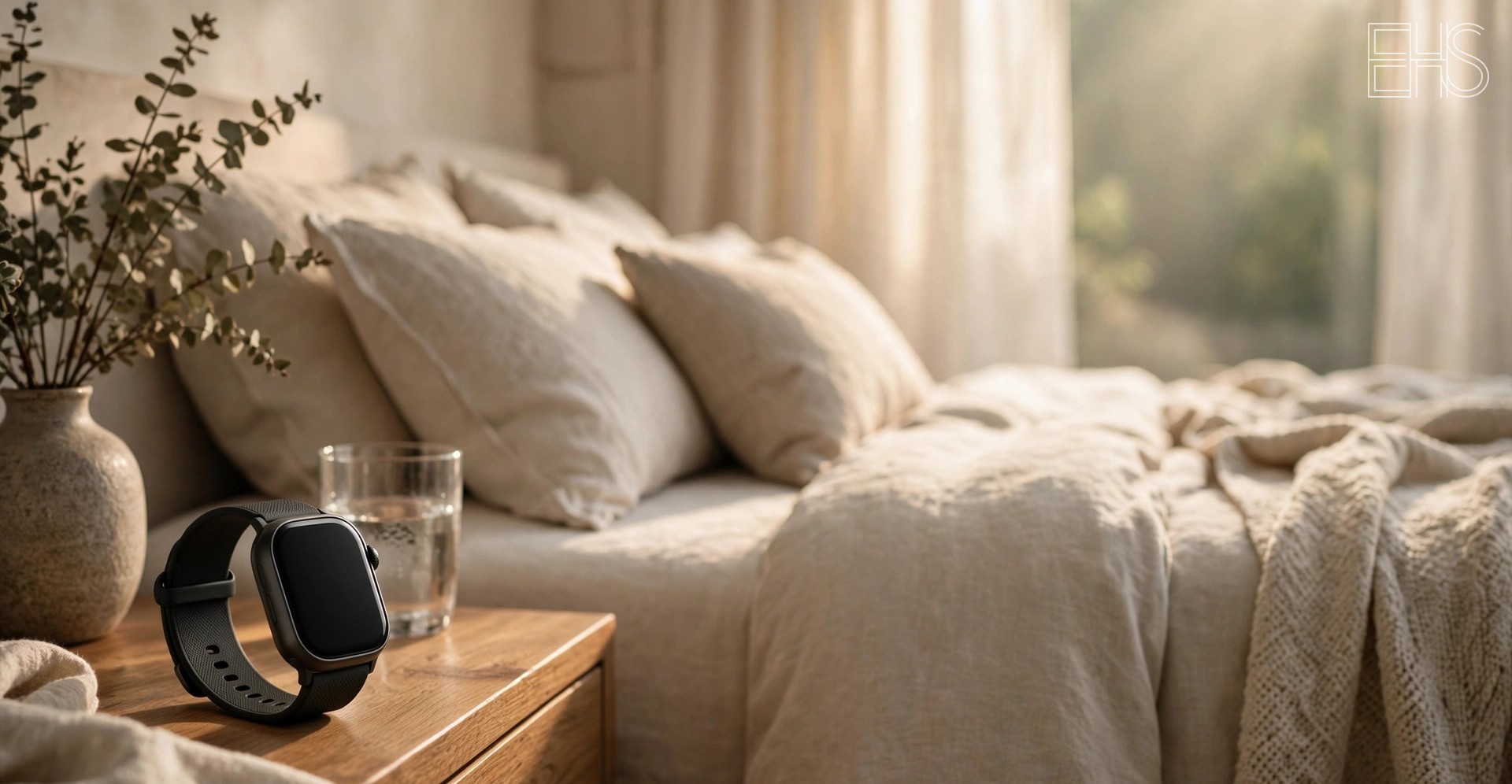
A generation ago, knowing how you slept meant remembering how you felt at 7 a.m. Now a ring, watch, or strap delivers a nightly report card: a sleep score, minutes logged in light, deep, and REM stages, heart rate curves, even a "readiness" number for the day ahead. The marketing is confident. The validation literature is more modest: good at some things, shaky at others. Here is the evidence, claim by claim.
What the Devices Actually Measure
Almost every consumer tracker on the market estimates sleep from the same small toolbox of sensors:
- Movement (actigraphy). An accelerometer detects whether the wrist or finger is still. Stillness is the oldest and bluntest proxy for sleep.
- Optical heart rate (photoplethysmography, or PPG). Green LEDs measure blood flow changes to estimate heart rate, and heart rate patterns help infer sleep stages.
- Heart rate variability (HRV). Derived from beat-to-beat timing, HRV shifts across sleep stages and is fed into staging algorithms.
- Skin temperature, SpO2, and respiratory rate. Newer devices add these, mostly as supporting signals rather than primary ones.
What none of these do is read brain waves. The reference standard for sleep measurement, polysomnography (PSG), scores sleep from EEG brain activity, eye movements, and muscle tone. Everything a wrist or finger device reports is an inference from peripheral signals, computed by proprietary algorithms that change with firmware updates, which means a validation study from two years ago may describe software that no longer exists.
How to Read a Validation Study
A little vocabulary goes a long way. Sensitivity is how well the device detects sleep when PSG says the person is asleep; specificity is how well it detects wake. Consumer devices tend to have high sensitivity and poor specificity: they are generous about calling things sleep. Studies also report epoch-by-epoch agreement (the device's verdict versus PSG's in 30-second windows), bias (whether a device systematically over- or under-estimates), and the width of individual errors. One more caveat: most validation studies recruit healthy, young, good sleepers, and performance typically degrades in older adults and people with fragmented sleep, which is exactly the population most motivated to buy a tracker.
What the Evidence Suggests
Total sleep time and sleep versus wake: reasonably good
This is the strongest territory for consumer devices. Multisensor trackers generally estimate total sleep time within roughly half an hour to an hour of PSG, which is useful for tracking trends. The consistent pattern across studies is overestimation: the devices mistake quiet wakefulness for sleep, because lying still while reading or scrolling looks a lot like light sleep to an accelerometer and a steady heart rate.
Practical takeaway: for the big-picture question, "about how long did I sleep," a modern tracker is a serviceable instrument. For the finer question, "how much of the night was I actually awake," it leans optimistic. People who lie awake in the dark should expect their tracker to be kinder than reality.
Sleep stages (light, deep, REM): weak
Here the evidence turns cool. Epoch-by-epoch agreement between consumer devices and PSG for specific stages often lands in the 60 to 70 percent range in published validations, and some of that agreement is chance, since light sleep dominates the night. Deep sleep and REM get confused with each other and with light sleep regularly, and different devices disagree with each other about the same night.
The algorithms are also moving targets. Manufacturers refine staging models with each firmware generation, so a study validating one software version may not describe the version on your wrist, and independent researchers cannot inspect the proprietary formulas.
Practical takeaway: treat nightly stage minutes as rough estimates, not measurements. A report of 47 minutes of deep sleep is better read as "some deep sleep happened" than as a precise quantity.
Nighttime heart rate: strong
This is the quiet success story. At rest, away from motion, wrist PPG tracks reference heart rate closely, and overnight recordings are the easiest case: the wearer is still for hours. Validation studies of nighttime heart rate from major devices show close agreement with ECG-derived rates. This is the signal with the best claim to accuracy on your wrist.
Practical takeaway: resting heart rate trends across weeks are the most trustworthy number most trackers produce. A slow upward drift in overnight heart rate is a genuinely useful signal that something in your routine changed.
Heart rate variability: mixed
HRV estimates correlate reasonably with reference measurements in several validation studies, particularly for common metrics derived from overnight windows. The complications are real, though: HRV has many definitions (rMSSD, SDNN, proprietary composites), devices do not always disclose which one they compute, and the averaging window matters enormously. Two devices on the same wrist can report different "HRV" numbers because they are measuring different things under the same name.
Practical takeaway: HRV is useful as a personal trend on one device, compared against your own baseline. It is not useful as an absolute number compared across brands or against population norms in an app.
Sleep scores and readiness numbers: unvalidated composites
The single number on the home screen, the sleep score or readiness index, is where evidence ends and marketing begins. These are proprietary blends of the signals above, weighted by formulas no independent researcher has validated. No published literature shows that a "sleep score of 82" predicts anything about morning alertness or performance, and the score can shift between firmware updates without your sleep changing.
Practical takeaway: if the score motivates consistent bedtimes, it has done something useful. If you find yourself anxious about a number you cannot audit, the feature is costing more than it gives.
Blood oxygen and respiratory metrics: promising but limited
Wrist-based SpO2 estimates correlate loosely with finger oximetry in validation studies, but agreement is modest and motion-sensitive. Respiratory rate estimates fare slightly better during still sleep. Neither has been validated as a screening tool for sleep-disordered breathing in general users, whatever the marketing implies.
Practical takeaway: interesting secondary signals, not substitutes for dedicated measurement.
How the Main Device Types Compare
No single ranking fits everyone, because accuracy varies by what you ask the device to do. Broadly, validation studies support this pattern:
| Device type | Total sleep time | Sleep stages | Nighttime heart rate | HRV | Typical list price |
|---|---|---|---|---|---|
| Multisensor smartwatch | Decent, overestimates | Weak | Strong | Mixed | Typically from around $250 to $800 |
| Smart ring | Decent, overestimates | Weak to moderate | Strong | Mixed | Typically listed at $299 to $549, plus app subscription |
| Fitness band | Decent, overestimates | Weak | Good | Mixed | Typically from around $100 to $200 |
| Chest strap (night use) | Fair | Not reported | Strong | Good | Typically from around $80 to $130 |
| EEG headband | Good | Moderate to good | Not the point | Not the point | Typically from around $300 to $500 |
Two notes on the table. First, the EEG headband is the outlier: it measures brain activity directly, so its staging is genuinely better, but headbands are less comfortable and remain a niche product. Second, "weak to moderate" for ring staging reflects a few newer studies with encouraging results on specific models, not a settled verdict.
Pricing across the category moves constantly, with subscriptions adding roughly $6 to $12 per month on several platforms, so verify current rates before booking a device trial or an in-lab comparison study. (An overnight in-lab sleep study at a specialized center is typically listed from around $1,500 to $3,000, which is the price of ground truth.)
The Claims to Retire
| Claim | Verdict |
|---|---|
| "Lab-grade accuracy" | Overstated. Agreement with PSG is decent for sleep versus wake and poor for stages. |
| "Precisely tracks your REM and deep sleep" | Not supported. Stage classification is the weakest domain in the validation literature. |
| "Detects sleep apnea" | Not validated for screening in general users. Respiratory signals are the least reliable domain. |
| "Your sleep score tells you how recovered you are" | No published evidence that composite scores predict recovery or performance. |
| "More data means better sleep" | The evidence points the other way for some users: score anxiety is a documented phenomenon. |
| "All brands measure the same thing" | False. Proprietary algorithms and undisclosed HRV definitions make cross-brand comparison unreliable. |
What Would Change Our Minds
The field knows what better evidence looks like: large, independent, pre-registered validations in diverse populations, including older adults and people with sleep complaints; published algorithm descriptions so results can be reproduced; and outcome studies asking whether tracker-guided behavior change actually improves sleep. Until that literature exists, treat every precision claim as provisional.
The Honest Bottom Line
A sleep tracker is a good behavioral instrument and a mediocre measuring instrument. Used for trends, bedtime consistency, and resting heart rate across weeks, it earns its place on the nightstand. Used as a nightly judge of sleep architecture, it promises more than validation studies support. The most useful question it answers is not "how did I sleep last night" but "what does my month look like".
For related reading, our evidence review of cold plunging covers what the research says about cold immersion and sleep, our sauna evidence review looks at heat bathing and sleep quality, and our contrast therapy protocols discuss evening routines that pair heat and cold.
Frequently Asked Questions
Can a smartwatch tell which sleep stage I am in?
Approximately, not precisely. Watches infer stages from movement, heart rate, and HRV patterns rather than measuring brain activity, and validation studies show stage-by-stage agreement with polysomnography in the 60 to 70 percent range. Treat stage minutes as rough estimates and put more trust in total sleep time trends.
Why does my tracker say I slept more than I feel I did?
Consumer devices systematically overestimate sleep because their specificity for wakefulness is poor: lying still while awake looks like sleep to the sensors. If you spent an hour awake in the dark without moving much, the tracker likely scored part of it as light sleep. This bias is one of the most consistent findings in the validation literature.
Are sleep trackers accurate for people with insomnia or fragmented sleep?
Less accurate than for good sleepers, which is the population most validation studies recruit. Fragmented sleep, frequent awakenings, and long periods of still wakefulness are exactly the conditions where actigraphy-based scoring struggles. If your sleep is troubled, the tracker's numbers deserve extra skepticism.
Do firmware updates change how my sleep is scored?
They can. Manufacturers refine staging models with each update and rarely publish what changed, so a sudden shift in your scores may reflect software, not physiology. Another reason to follow long trends rather than nightly digits.
Can a tracker detect sleep apnea?
No consumer wearable has been validated as a screening tool for sleep-disordered breathing in the general population. Wrist SpO2 and respiratory signals show only loose agreement with reference measurements and are sensitive to motion and fit. Unusual patterns are worth discussing with a qualified professional, but the tracker is not a screening device.
Is an EEG headband worth it over a watch or ring?
If precise staging is what you want, headbands have a real advantage: they measure brain activity, which is what staging is defined by. The tradeoffs are comfort, a smaller validation literature, and a narrower feature set for daytime metrics. For most people tracking general sleep trends, a watch or ring plus attention to consistency is the more practical setup.
Everything here is general information about sleep technology, not personal health guidance. Talk with a qualified professional about decisions that affect your health.