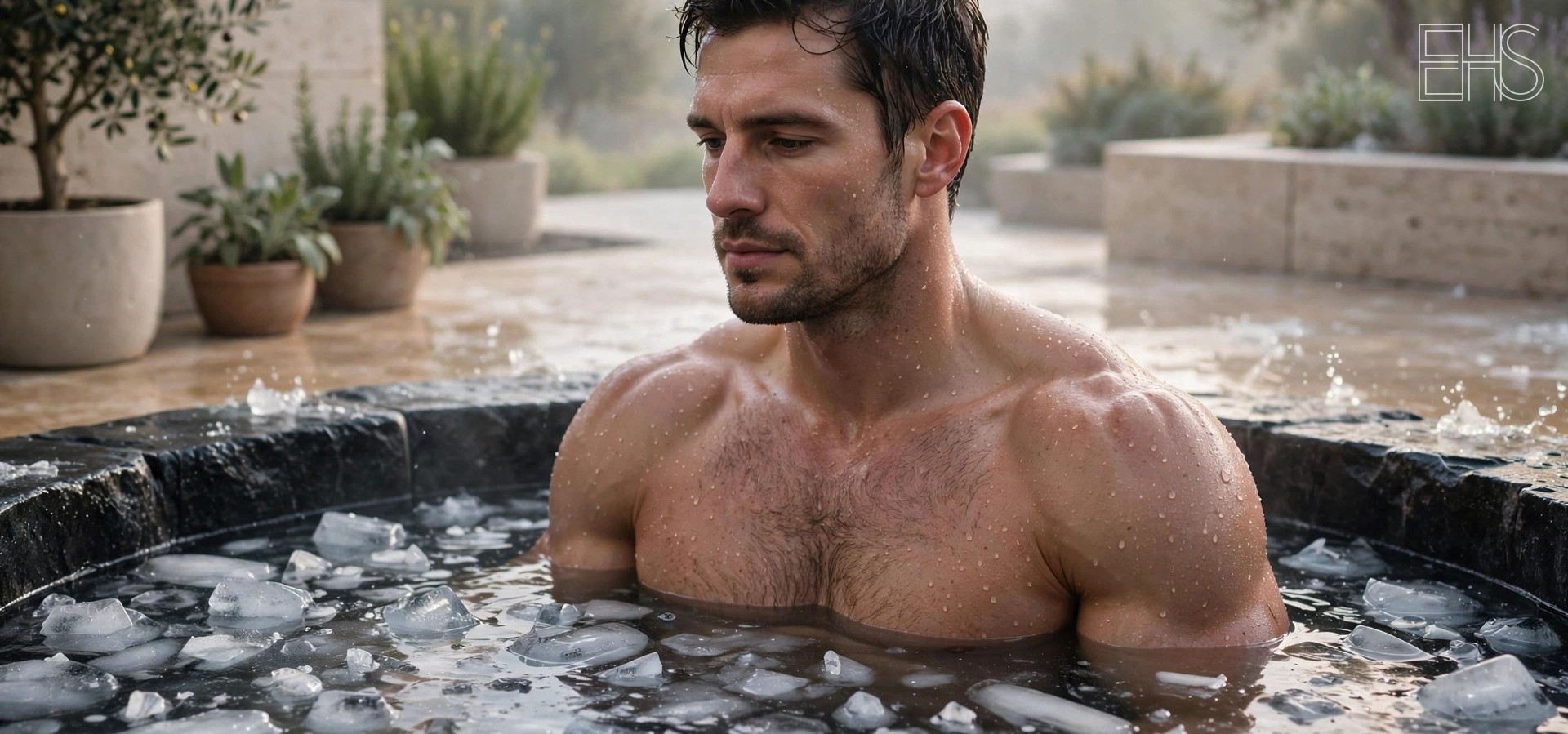
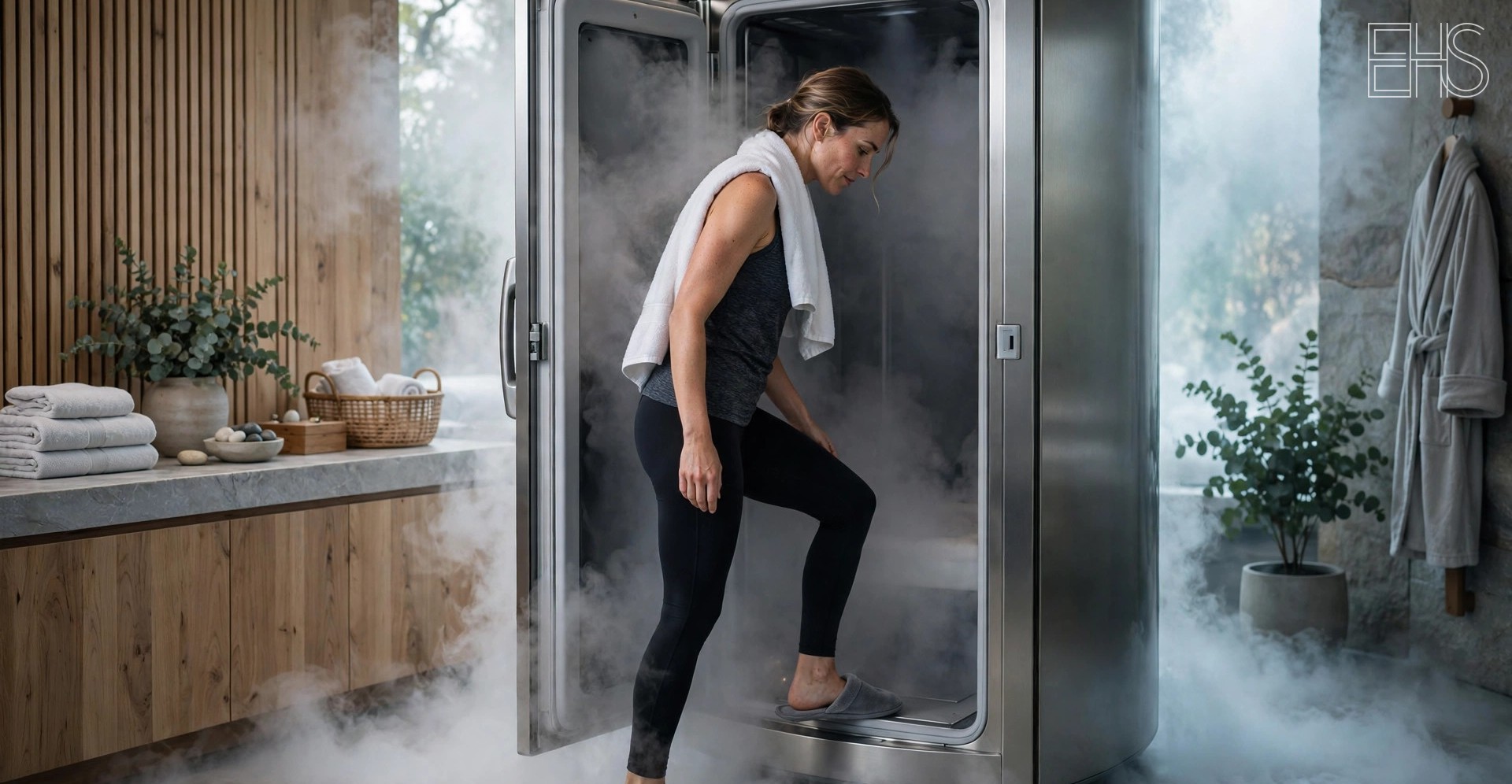
Step into a chamber filled with nitrogen vapor at temperatures far below anything in nature, stand there for two to three minutes while your skin temperature plummets, and step out feeling electric. Whole-body cryotherapy has spread from sports training rooms to high-street wellness studios, and its claims have grown with it: faster recovery, less inflammation, better sleep, sharper metabolism, even mood transformation.
Some of this has evidence behind it. Much of it is borrowed from adjacent research, particularly cold-water immersion, and applied to a very different exposure. Here is the careful version.
How to Read This Literature
Whole-body cryotherapy (WBC) research comes with specific interpretation problems:
- Air is not water. Cryotherapy chambers cool the skin through frigid air, typically around minus 110 to minus 140 degrees Celsius. Cold-water immersion cools through water, which removes body heat materially faster than air. Physiologically, these are different exposures, and evidence from ice baths does not automatically transfer to chambers.
- Tiny samples. Many WBC trials enroll 10 to 25 participants. Effects that look dramatic in a group of twelve often shrink or vanish in larger samples.
- Athlete-heavy populations. Most research studies trained athletes after intense exercise. Findings about post-match recovery in professional rugby players may not generalize to a studio client seeking general wellness.
- Impossible to blind. Nobody mistakes a minus 130 degree chamber for a placebo. Subjective outcomes like soreness and perceived recovery are inflated by expectation.
- Short follow-up. Sessions are measured in minutes and most trials last days to weeks. Long-term outcomes are essentially unstudied.
The calibration: cautious confidence for short-term perceived recovery effects; skepticism for systemic health claims.
Post-Exercise Soreness: The Best-Supported Claim
The most consistent finding across WBC trials is a reduction in perceived muscle soreness after intense exercise, similar in pattern to what cold-water immersion studies show. Several small randomized trials and at least one systematic review found that athletes reported less soreness in the 24 to 72 hours after hard sessions when they used cryotherapy compared with passive rest.
The emphasis belongs on "perceived." Objective measures of recovery, like strength restoration or sprint performance, show smaller and less consistent effects. This mirrors the cold-water literature: the subjective relief is real and repeatable, the functional recovery less so.
Practical takeaway: for an athlete whose limiting factor is how sore they feel between sessions, WBC has the best evidence in its portfolio. For measurable performance recovery, the evidence is thinner.
Inflammation Markers: Mixed and Unclear
Cryotherapy is widely marketed as anti-inflammatory, and some trials have measured changes in inflammatory markers after sessions. The results are inconsistent: some markers shift in some studies, others do not, and the direction is not always what the marketing suggests.
There is also the deeper question of whether blunting inflammation after exercise is even desirable. As with cold-water immersion, post-exercise inflammation is part of the adaptation signal, and there is some evidence that habitual cold exposure right after resistance training may slightly reduce long-term strength gains. The WBC literature has barely begun to address this trade-off.
Practical takeaway: "reduces inflammation" is too crude a summary of a mixed and incomplete picture.
Mood and Alertness: Plausible, Short-Term
Many users report a distinct mood lift and alertness after a session, and there is a plausible mechanism: extreme cold triggers a sharp release of norepinephrine, the same alertness-related response seen in cold-water immersion. What is missing is any rigorous measurement of mood effects beyond immediate self-report, and certainly nothing on longer-term mood outcomes.
Practical takeaway: the post-session buzz is a real, short-lived physiological response. Anything beyond that is anecdote.
Sleep: Thin
Some studios claim cryotherapy improves sleep, and a few small studies have looked at sleep questionnaires after WBC protocols. The evidence is sparse, the samples tiny, and the outcomes subjective. There is no strong basis for choosing cryotherapy as a sleep intervention.
Metabolism and Weight: Not Supported
The idea that extreme cold "activates brown fat" and meaningfully changes metabolism is borrowed from cold-exposure research generally, and it loses force in translation. WBC sessions last two to three minutes in air, which cools the skin dramatically but changes core temperature only slightly. The metabolic stimulus is brief and small. No credible trial has shown meaningful fat loss or metabolic change from WBC protocols.
Skin and "Anti-Aging": No Serious Evidence
Some studios market cryotherapy for skin tightening or visible rejuvenation. The evidence base for cosmetic effects is essentially nonexistent: no rigorous trials, no plausible sustained mechanism from a three-minute cold air exposure. This is pure marketing.
Longevity: Unknown
No study has measured lifespan or healthspan outcomes from whole-body cryotherapy. Any longevity framing is speculation built on mechanisms, not data.
Chamber vs. Ice Bath: A Direct Comparison
Because cryotherapy marketing often borrows credibility from cold-water research, the differences deserve precise statement.
| Cryotherapy chamber | Cold-water immersion | |
|---|---|---|
| Medium | Frigid air, around minus 110 to minus 140 C | Water, typically 50 to 59 F (10 to 15 C) |
| Session length | 2 to 3 minutes | 2 to 5 minutes |
| Core temperature change | Slight | Moderate |
| Soreness evidence | Moderate, mostly athlete studies | Moderate, broader study base |
| Typical session cost | Listed from around $40 to $90 | Near zero at home |
| Evidence transfer | No; different exposures | No; different exposures |
The practical implication: a chamber is a premium delivery mechanism for a milder cold stimulus, with the advantage of convenience and the disadvantage of cost. Anyone choosing between them on evidence alone should know the ice-bath literature is larger while the effect sizes are similar.
The Claims to Retire
| Claim | Verdict |
|---|---|
| "Burns fat / boosts metabolism" | Not supported; brief air exposure is a small metabolic stimulus. |
| "Flushes toxins" | No meaningful evidence; the language is marketing. |
| "Anti-aging for skin" | No rigorous trials; no plausible sustained mechanism. |
| "Wipes out inflammation for good" | Mixed marker data; adaptation trade-off unaddressed. |
| "Equivalent to an ice bath" | Different exposure; evidence does not transfer automatically. |
| "Extends lifespan" | Zero human evidence. |
Safety: Not for Everyone
Extreme cold is a genuine physiological stressor, and it is not for everyone. People with cardiovascular conditions, uncontrolled blood pressure, cold sensitivity disorders, or open wounds should not use cryotherapy chambers, and anyone unsure should get personal guidance first. Sessions are brief by design, and longer is not better: the standard protocols studied are two to three minutes, and exceeding them adds risk without evidence of added benefit.
Cost and Access
Studio sessions are typically listed from around $40 to $90 per session in major markets, with package and membership pricing bringing the per-session figure down. Home cryotherapy chambers exist but are priced in the tens of thousands of dollars and remain rare outside professional sports facilities. As always with service pricing, treat figures as approximate and verify current rates before booking.
What Would Change Our Minds
The field needs large randomized trials in general populations, lasting months rather than days, with pre-registered methods and objective outcomes: illness rates, strength and performance over time, sleep measured by actigraphy rather than questionnaires. Until that literature exists, every claim beyond short-term perceived recovery should be treated as provisional.
The Honest Bottom Line
Whole-body cryotherapy has one credible, well-repeated finding: it makes sore athletes feel less sore for a day or two. Everything else in the marketing brochure, from fat loss to skin rejuvenation to longevity, outruns the evidence by a wide margin. The chamber experience itself, brief, intense, oddly exhilarating, is real and many people enjoy it. Just do not confuse an enjoyable ritual with a proven health intervention.
For the adjacent evidence on cold-water immersion, which is better studied, see our cold plunge evidence review. Our contrast therapy protocols guide covers hot-cold cycling for those comparing approaches, and the cold plunge versus sauna comparison puts the two flagship modalities side by side.
Frequently Asked Questions
Is whole-body cryotherapy the same as an ice bath?
No. Chambers cool the skin with frigid air for two to three minutes; ice baths cool the body through water, which transfers heat far faster and lowers core temperature more. They are different exposures, and study results from one do not automatically apply to the other.
How cold does a cryotherapy chamber actually get?
Chamber air is typically set between around minus 110 and minus 140 degrees Celsius, though the number on the display is the air temperature, not your body temperature. Skin temperature drops sharply during the session while core temperature changes only slightly.
How many sessions do studies typically use?
Research protocols vary, but many trials used daily sessions for five to ten days, or sessions after specific training bouts. There is no established evidence-based protocol for general wellness use, and most studio recommendations are extrapolated from athlete studies.
Does cryotherapy help with weight loss?
There is no credible evidence that whole-body cryotherapy produces meaningful fat loss. The metabolic stimulus of a two-to-three-minute air exposure is brief and small, and no rigorous trial has shown changes in body composition.
Can I use cryotherapy if I have high blood pressure?
Extreme cold causes a sharp, temporary rise in blood pressure and heart rate, which is why cardiovascular conditions are the main caution area. This is a question for personal professional guidance, not a studio intake form. When in doubt, skip it.
Is there any long-term research on regular cryotherapy use?
Essentially none. The literature consists of small, short-term trials measuring immediate or near-term outcomes. Long-term effects, positive or negative, of habitual use over months or years are unstudied.
This guide is for general information about cryotherapy and is not medical advice. Consult a qualified professional before making health decisions.